
 August 5, 2007
Hearing tech industry history…

A few weeks ago Mrinal Desai wrote me on Facebook and said I had to meet his new boss.
I had no idea who Mrinal was, nor did I know anything about his boss or the new company he was pitching to me. Crossloop.
But, that little conversation led me to a phone conversation where he gave me a little taste of what was to come and got me more interested. His boss worked at Digital Research back in the early 1980s with Gary Kildall. My ears instantly perked up.
Don’t know who Gary Kildall is? You should. He’s the one that Bill Gates beat.
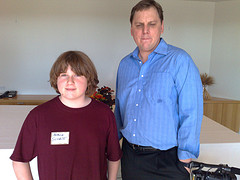
So, today I took Buzz and my son down to Pacific Grove to meet Mrinal and his boss.
And it just got more and more interesting.
His boss is Tom Rolander.
He was flying with Gary Kildall the day that IBM came knocking and asking to license Digital Research’s CPM.
You know the rest of the story. Digital Research lost to Microsoft and its DOS, which came from Tim Paterson who worked at a Seattle Computer Store.
But I had never before heard the story straight from the guy who was flying with Gary. I’ll get the video up this week. It’s an incredible piece of computing history.
The house above? That’s the house that IBM came and tried to get a deal with Digital Research and that’s Tom today.
Make sure to subscribe to ScobleShow. You won’t want to miss this one.
And that’s not the only incredible interview we have coming up on ScobleShow this week — also coming are interviews with IBM’s top intellectual property lawyer and a visit to Stanford University’s computer science department where we meet one of the smart people shaping the future there. I love how during the interview we nonchalantly learn that Google was started “across the hall.”
I love my job and thanks to Seagate for funding all of this (Tom even tells a story about Seagate’s founder, Al Shugart, inventor of the hard drive). I pinch myself every morning that I get to hang around such incredible people.
I wonder who’ll be next to introduce themselves in Facebook?
August 4, 2007
FaceSlammed by Bill Gates
About a month ago I found Bill Gates, co-founder of Microsoft, and added him as a friend on my Facebook network. But he did something that is termed “FaceSlamming.” He didn’t add me as a friend to his Facebook network. How do you FaceSlam someone else?
Let’s look. Right now I have six friend requests. It asks me to “confirm” or “ignore” a friend request. If I ignore a friend request, I’ve “FaceSlammed” them. They won’t get a notice, but they’ll see that they aren’t getting added to my Facebook group and they won’t be able to see my videos or other content I’m putting into Facebook. Basically they wouldn’t get access to my walled garden.
Other people who’ve FaceSlammed me? Nick Denton of Gawker media. Heheh. The gestures one can throw at someone just by clicking “Ignore.” 
Anyway, how do you pick out the real Bill Gates on Facebook? (There are quite a few to choose from).
Well, I talk about that on a video on my Facebook Profile this morning. To get access to it you’ll need to Confirm our friendship.
July 30, 2007
Technology Bloggers, what are they good for?
Dare Obasanjo asks “what are those A-list technology bloggers good for?”
He’s absolutely right! (I’ve been saying that a lot today — I’m in a very agreeable mood).
The thing is I’ve been keeping my own “A list.” I judge 772 feeds (which represents thousands of blogs since some of my feeds, like Microsoft’s feed, has more than 3,000 bloggers on one feed).
I judged 35,609 items in the past 30 days, according to Google Reader. Out of all those items I shared 1,094 items with you.
To get onto my feed reader you’ve gotta do something better than the average blog. You’ve gotta bring the best of tech through my feed reader. If you don’t I unsubscribe and I go somewhere else.
Out of all those feeds Google Reader keeps track of the top 35 feeds. This is the new A list and DARE IS ON IT.
See, he better watch attacking the A list tech bloggers because he now is one.
I think that’s called a “looping flame.” Where you intended damage to happen somewhere else but it came back to focus on you. Ouch.
1. Mashable
2. Read/Write Web
3. TechCrunch
4. Media 2.0 Workgroup
5. digg
6. Sun bloggers
7. Gizmodo
8. ZDNet blogs
9. Planet Intertwingly (a bunch of bloggers show up here, including Dare).
10. All Facebook
11. MSDN Blogs
12. digg/Technology
13. The Unofficial Apple Weblog (TUAW)
14. RSS Feed for Lifehacker
15. GigaOM Network
16. VentureBeat
17. Chuqui 3.0
18. VentureBeat Wire
19. Y Combinator Startup News
20. Engadget
21. TechNet Blogs
22. Digital Backcountry - Ryan Stewart’s Flash Platform Blog
23. JD on EP
24. Google Operating System
25. A Welsh View
26. dzone.com: latest front page
27. All Things Digital
28. Dare Obasanjo aka Carnage4Life
29. Valleywag
30. Googlified
31. Ryan’s shared items in Google Reader
32. rexblog: Rex Hammock’s Weblog
33. Metaversed - Business and Technology News from the Metaverse
34. Business 2.0 Beta Blogs
35. CrunchGear
Anyway, I threw an answer to Dare up on my Kyte.tv channel as well.
July 28, 2007
Calacanis asks deep questions about social networks
So Jason “no comments” Calacanis answers me, and others, back about his increasing dislike of Facebook and other social networks.
First of all, for the record, Jason is right. Facebook sucks. Twitter sucks. Pownce sucks. Jaiku sucks. Kyte sucks. Etc and etc.
Why? Because they take time.
But then managing my Outlook contact list took time. Managing my business card collection took time. My mom took time to keep a filing cabinet and an address book and a rolodex.
Facebook is the modern day rolodex. It is the replacement for the business card.
First of all, let me attack a claim Jason made that simply is wrong: that it takes 30 minutes a day to add hundreds of new friends into Facebook or other social networks (on big days I’ve actually had hundreds of people wanting into my social network, so I timed it: I can add hundreds in less than five minutes).
Here’s how.
Let’s go to Facebook and look. Gary Chan just asked to be added to my network. I click confirm. Then “skip this step.” Done. Typing this sentence took four times longer. You don’t need to do anything more. You don’t need to explain why you know Gary Chan. Etc. Etc. I never do and I don’t feel guilty about it. If I know people I know why and how I know them and I don’t need to tell you all that. Later on I might add some value to my contact list that way.
So, why do I say it’s my new business card collection? Well, if I am looking for a contact, at, say, Yahoo, I troll through my Facebook collection. Most Yahoo employees leave their phone numbers and email addresses on their Facebook profile. Hint: they work on the iPhone. So, I visit their profile and click on their phone number and I’m instantly connected.
Plus, I know everything about them that they’ve wanted to share.
For instance, Bradley Horowitz, of Yahoo, is on my contact list. By looking at his profile page I know all sorts of stuff about him. His relationship status, his political views, who his friends are, what kind of music he likes, his favorite TV shows, his favorite movies, his favorite books.
He has the Snapvine app, so I can leave a voice mail for him. He tells his friends where he lives (has a Yahoo Map gadget that shows that, of course). Puts all his Flickr photos up. I know his mood. I know what party he’ll be at tonight. I know someone at Microsoft that he’s talking with and who visits his page, so I know some influence networking that I could do with him. I know his college experience and his past work experience.
All voluntarily turned over and when I interview him do you want to bet this stuff comes up? Damn straight it will.
If I go to the party he’s going to tonight (I might, it’s on my calendar too) I’ll have TONS of stuff to talk with him about. Music. Movies. TV shows. Politics. College experience. And other stuff.
Oh, heck, let’s go look at Jason’s Facebook. I see his religious views. Jason has put his mobile number there. His educational experience. And more. Plus I can see who wants to suck up to Jason on his wall (I’m there, so read into that what you want. By the way, so is the co-founder of Flickr, the founder of B5 Media network, and a bunch of other interesting people).
I also like that all his Twitters are there, so I can see what else Jason’s been ranting about without being forced to chase Jason all over the Net. On my profile you can see my Twitter, Jaiku, Pownce, Kyte, Wordpress, Google Reader, and many other things. That saves you time of figuring out everything I’m doing.
Now, can I get this info any other way? LinkedIn? Maybe. Twitter? No. Pownce? No. Jaiku? No. Following his blog? No. Kyte? No. MySpace? Don’t be ridiculous.
Could I have called him? Yeah. I have his business card and his mobile phone in my contacts. But why would you waste Jason’s time asking stupid questions when the answer is already online? Will that lead to a good result? A ride in his Corvette, for instance? Or a business partnership?
Anyway, let’s specifically answer some questions Jason asked, cause they are interesting:
1. Facebook is a multilevel marketing platform. Jason’s right. But, then, so is my rolodex from the 1980s and 90s. Some people in that rolodex are a LOT more important to me than other people. Some people in that old-school rolodex introduced me to TONS of other people and influenced my life in major ways. That rolodex is now moving to Facebook where it’s getting MUCH stronger than it was on little business cards or in Outlook where I didn’t have pictures and didn’t have an ability to see inside the networks of friends each person has (Facebook lets me see all of your friends as well, if you leave that open, which most people do).
2. Facebook is a great way for me to promote what I’m doing. Absolutely. Jason’s right there! But it’s NOT one way! Hint: great parties, great people come to you, too. I’ll have a lot more to say about that soon.
3. Are we creating a social system to communicate with each other at a distance because the reality of creating and maintaining that social networking face-to-face is, well, scary? Well, I’m sure that some people would be scared by getting a ride in Jason’s Corvette, but I’ve been there and it was one of the greatest thrills of my life. Can I experience that over Facebook? No, but Jason’s phone number is on his Facebook so you can always call and invite him out for dinner.
4. Is Facebook a more efficient, rejection-free, surrogate for the real world? Um, Nick Denton didn’t accept my friend request. So, no, it’s just like the real world where some people think you’re an asshole and other people think you’re cool. I notice that Jason has enough people who think he’s cool that there’s an entire group of people who think he’s cool on Facebook. Seriously. Do a search on Jason’s name and you’ll find the group.
5. At a certain point social networks create negative returns on your investment. Absolutely. These things get noisy the more people you add to them. So, if you want to have no noise definitely don’t have any friends. Or keep your networks down to only your “real” friends instead of anyone who wants to come in. My strategy? I’m going with the noise cause I don’t know where the gold is going to come from. I realize not everyone is a weirdo like me in that regard.
6. Are we going to hire someone to manage our social networks? I haven’t yet and I doubt I will. My friend network is too important to me and there’s all sorts of gestures that are coming to me through it that I’d miss if some intern was tending to my network.
Anyways, interesting discussion. If I were really smart I wouldn’t be engaging in this right now and, instead, testing out the new CoComment that came out yesterday. Now THAT is interesting.
Of course now that Jason has closed down comments maybe that’s not so interesting after all.
July 27, 2007
TechCrunch TwitterGrams
Experience a little bit of the TechCrunch party — 30 seconds of audio at a time.
David Weekly of PBWiki with a little adoption news about their wiki service.
OpenDNS’s CEO, David Ulevitch (a little hard to hear, but he was telling me why OpenDNS is a cool service — I’m going to try it out and get over there for an interview).
Ash Damle, CEO of Medgle, a personalized medical search engine, explains why his service is unique.
Bradley Horowitz, of Yahoo (the guy who bought Flickr) talks to me about what he’s excited about.
Dave Winer talks to me about TwitterGram.
Ryan Hoge and Doug Pierce of Microsoft talk to me about FolderShare and LiveFolders from Microsoft.
And before the party Larry Magid (famous tech journalist) told us that he’s partnering with PodTechww on a show called Digital Crossroads.
July 26, 2007
Ray Ozzie coming out of his shell
Mary Jo Foley is covering Microsoft’s Financial Analysts’ Meeting where they are announcing a range of new infrastructure. My friends at Microsoft are pretty hyped up about this, so I’ll be following the announcements closely and hoping to get a better look when I visit Seattle for the Gnomedex conference in a couple of weeks.
Ray Ozzie is expected to announce some major new services infrastructure. Steve Ballmer threw a new name out there, which Mary Jo caught: Windows Live Cloud Infrastructure.
There’s a lot more on the news coming out of the analyst meeting on TechMeme today and I’m sure there’s more to come after Ray Ozzie finishes.
A Web-based IM that “sticks” to the desktop
I’m not a heavy IM user anymore, so not sure Velvet Puffin’s Web-based instant messaging service will really take off the way that R. Chandrasekar is hoping it will (most of my IM traffic has gone to Twitter or Pownce) but it did do something worthy of note: You sign in with your Web browser and you get an IM client that looks like it’s part of the Web page. Close the browser, though, and the IM client sticks around.
This is the kind of “rich Internet application” that I’d expect to see tons of next year after Adobe’s AIR and Microsoft’s Silverlight get better understood (and get finished). Already Pownce has an Adobe AIR version that’s looks similar to an IM client. Anyway, I have an interview with R. Chandrasekar, CEO of Velvet Puffin, and he gives me a demo, too, which I’ll embed here for your viewing pleasure. He came to see me from Singapore, so we met in a restaurant near SFOs airport. Sorry if it’s a little noisy there.
JimDo: not your father’s FrontPage
Straight from Germany comes JimDo, an online service that lets you create your own Website.
Matthias Henze, co-founder, just was here showing it to me. It’s a Web site builder. I was a bit incredulous with him. “Why do we need another Web tool?”
But he was persistent and nice, explained how they released in China today and are already seeing nutty uptake and how they are getting great reviews.
I still was skeptical until I saw the demo. Wow. It’s like a cross between Adobe’s Dreamweaver and a wiki tool. All online and free. They have a pro version with more features.
One major problem that I banged Matthias on is that it doesn’t yet build RSS feeds. He said that’s a major feature they will add soon.
But if you are looking to build an online Web site, you should check out JimDo. I’ll have my videos of JimDo up next week if you don’t want to try it out before getting a good demo.
We also had a nice chat about what’s happening in Europe (today was Matthias’ first day in Silicon Valley) and I’ll get that up too toward the end of next week.
If I worked at Adobe or Microsoft on the Dreamweaver or Expression teams (which is what they changed the name of FrontPage to) I’d be looking at what this service lets users do. For a small business this kind of tool is a LOT easier to use. Just click on whatever you want to change and up come a bunch of options.
This is a good hint of what an online Office suite should do and feel like, by the way.
July 23, 2007
The search engine traction issue: privacy?
Is this the issue that Ask and Microsoft will get some PR traction on?
From my read of how people are responding to Google lately the answer is “yes.”
Google has not opened up its PR to grassroots bloggers that I can tell. Even big-name journalists tell me that Google is still giving them the standard PR tour of the kitchen and hasn’t had a “privacy summit” yet where journalists and bloggers and streaming video personalities are asked to come in and ask their toughest questions.
I don’t get why Google isn’t putting on the full-court PR press here.
Google doesn’t call, they don’t write, and they aren’t getting in front of the privacy story.
Which means that its competitors are going to out maneuver Google here. You know where to find me. I have lots of interview slots open this week.
UPDATE: or as TechCrunch writes: “privacy is the new black.”
Can you tell I’m reading feeds? Heh!
July 22, 2007
Feedburner bad for us?
Munir Umrani says: “I read the [Dave Winer] post twice and could not understand why Feedburner is trouble.”
The post he’s talking about? Dave Winer, who wrote “Why Feedburner is trouble.”
That caused a bunch of conversation over the weekend.
Ian Betteridge answers back “I could switch my feeds away from FeedBurner within a week.”
I disagree with Ian. If he switched his feeds from Feedburner that would break my news aggregator. I’d stop getting his feed and it wouldn’t be guaranteed that my aggregator would get his new feed. In fact, I’ll bet it’ll just stop getting Ian. Switching feed URLs at this point is audience suicide. If you don’t care about your audience you’ll do it.
UPDATE: Nick Bradbury, in my comments, says that you can move off of Feedburner feeds and most feed readers will respect that. (Read my comments on this thread for more).
But, what really is cooking here is that RSS has been moved to big companies to control. How so? Well, the RSS Advisory board, which includes members from Cisco, Yahoo, Netscape, FeedBurner (er, Google), Microsoft, and Bloglines and this new unofficial board +is+ changing the RSS spec all the time (they are now up to version 2.0.9. UPDATE: which only represents a couple of changes, according to comments left on this post). Dave Winer, who founded that spec says that’s in direct contradiction with the original charter of the RSS Advisory Board that he founded when he moved RSS from UserLand over to Harvard University.
So, the RSS spec already IS being changed. The big companies are in charge and we’ve gotta deal with any mess they get together and create for all of us.
I really don’t get why these big companies want to mess with the RSS 2.0 spec when the Atom spec, which is a formal standard, is out there. Why don’t they join the Atom committee and why do these big companies want to even have the appearance of messing with a spec that we all are happily using?
What is it with engineers and big companies that they always want to mess with RSS instead of getting together and coming up with a feed format with another name and do whatever they want with THAT? They tried to get the world to switch to Atom, failed, and now are coming back to mess with RSS. Again. Sigh.
If they did this to SMTP or HTTP or HTML wouldn’t the tech world be going nuts right now? Where’s the Web 2.0 version of the Web Standards Project?
Buy from Amazon:
| M | T | W | T | F | S | S |
|---|---|---|---|---|---|---|
| « Sep | ||||||
| 1 | 2 | 3 | 4 | 5 | 6 | 7 |
| 8 | 9 | 10 | 11 | 12 | 13 | 14 |
| 15 | 16 | 17 | 18 | 19 | 20 | 21 |
| 22 | 23 | 24 | 25 | 26 | 27 | 28 |
| 29 | 30 | 31 | ||||
ScobleShow (Scoble’s videoblog)
Blogroll
(From NewsGator)
Photoblog
(on Flickr)
Naked Conversations
(Book blog)
Main RSS Feed
Link Blog (tech news from Google Reader)
About me
Comment RSS Feed

Robert Scoble
robertscoble@hotmail.com
My cell phone: 425-205-1921

Robert Scoble works at PodTech.net (title: Vice President of Media Development). Everything here, though, is his personal opinion and is not read or approved before it is posted. No warranties or other guarantees will be offered as to the quality of the opinions or anything else offered here.
Login
Blog at WordPress.com.
